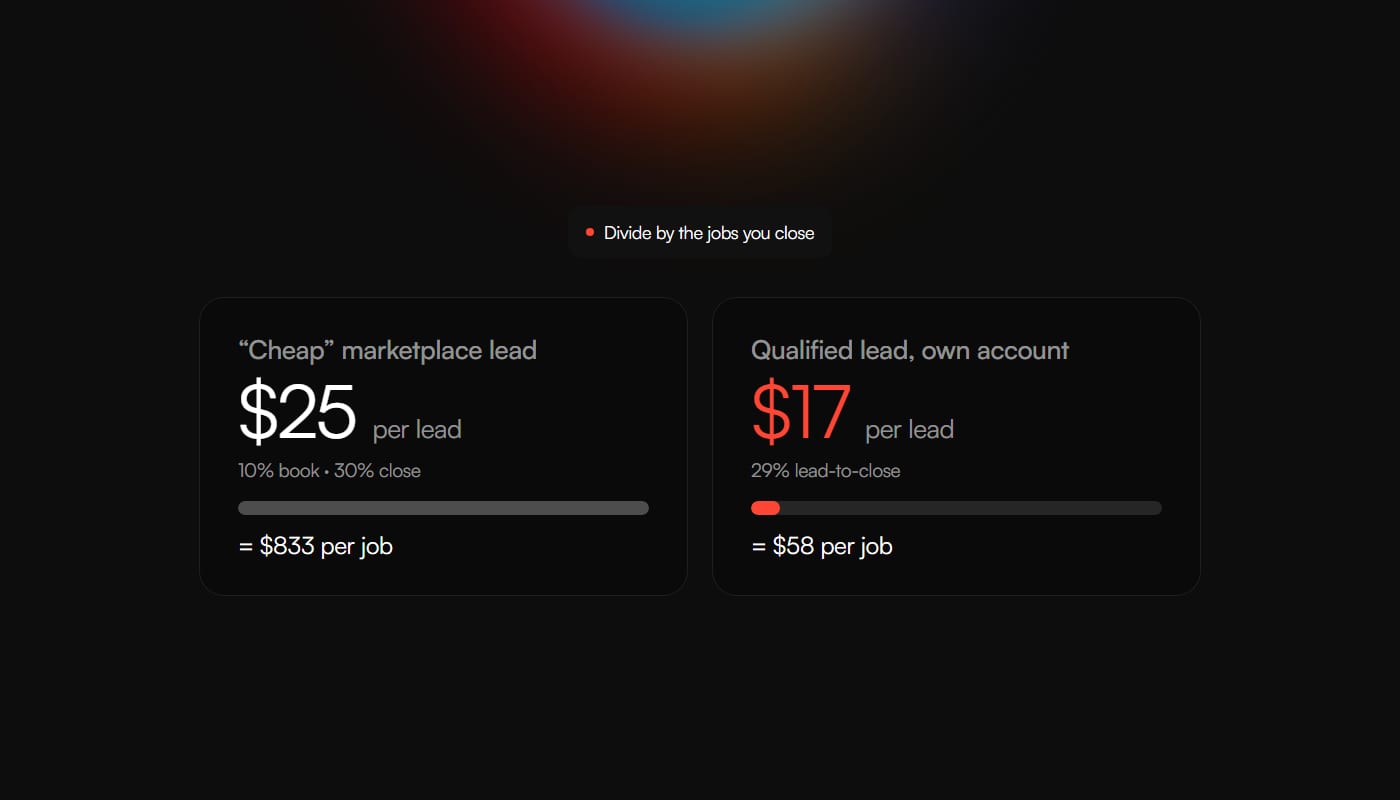
Pay-per-lead prices only the first step of a job. To compare offers, divide the lead price by the share that book and the share that close: a $25 lead at 10% booked and 30% closed costs $833 per job, while a $17 qualified lead at 29% lead-to-close costs about $58 per job. Ask whether leads are exclusive, what counts as billable, and whether the ad account is yours.
Pay-per-lead is the simplest offer in service business marketing: you pay a fixed price every time someone raises a hand. A roofing lead for $40, a plumbing lead for $25, an HVAC lead for $60. No retainer, no ad budget to manage, no creative to approve. On paper it is the lowest-risk way to buy work.
The catch is that a lead is not a job. Between "someone filled in a form" and "someone paid you" sit three filters — is it a real person, do they actually want the work done, and did you reach them before the other three companies they also contacted. Pay-per-lead prices only the first step. You carry the rest.
Do the division
Take any pay-per-lead offer and ask for two more numbers: what share of those leads become booked estimates, and what share of estimates close. Then divide.
- $25 leads, 10% book, 30% close — you pay $833 per job.
- $60 leads, 40% book, 35% close — you pay $429 per job.
- $17 leads, 29% lead-to-close — the number from our landscaping case study — works out to $58 per job.
The cheapest lead in that list is the most expensive job. That is not a trick of the example; it is the normal shape of pay-per-lead markets, because the vendor is rewarded for volume and you are rewarded for quality. The incentives point in different directions.
Where shared leads fall apart
Most pay-per-lead marketplaces sell the same enquiry to several companies at once. The homeowner did fill in a form — but they filled it in on a directory, not on your site, and they are now fielding calls from everyone who bought it. Your close rate on a shared lead is capped by how fast you dialled, not by how good your quote was.
If four companies bought the same lead, the best possible outcome is a 25% chance at a price war.
What to ask before you sign
- Is the lead exclusive? If not, ask how many others receive it.
- What qualifies as billable? Wrong number, out of area, "just pricing" — do you pay for those?
- Where does the lead come from? Your brand, or a generic directory page?
- Can you see the account? If the ads run in a vendor's account, you own nothing when you leave.
Pay-per-lead is not wrong. It is just priced on the wrong step. The model we run instead — ads in your own account, a qualifying form in place of an instant form, and follow-up that reaches every enquiry in minutes — costs more per lead and less per job, and the account screenshots are the argument.
Pay-per-lead is the simplest offer in service business marketing: you pay a fixed price
every time someone raises a hand. A roofing lead for $40, a plumbing lead for
A model where a service business pays a fixed price for each enquiry a vendor delivers — for example $25 per plumbing lead — instead of paying for ad spend and management. The vendor is paid per lead whether or not it becomes a job. Divide the lead price by your lead-to-booked rate and then by your estimate-to-close rate. $25 ÷ 0.10 ÷ 0.30 = $833 per job. $17 at a 29% lead-to-close rate is $58 per job. Rarely at the advertised price. If four companies receive the same enquiry, your best case is a one-in-four chance at a price war, and your close rate is capped by how fast you dial rather than how good your quote is. Is the lead exclusive? What qualifies as billable — wrong number, out of area, price-checkers? Where does the lead come from, your brand or a directory? And whose ad account do the campaigns run in?Common questions
What is pay-per-lead marketing?
How do I calculate cost per job from cost per lead?
Are shared leads worth buying?
What questions should I ask a pay-per-lead vendor?