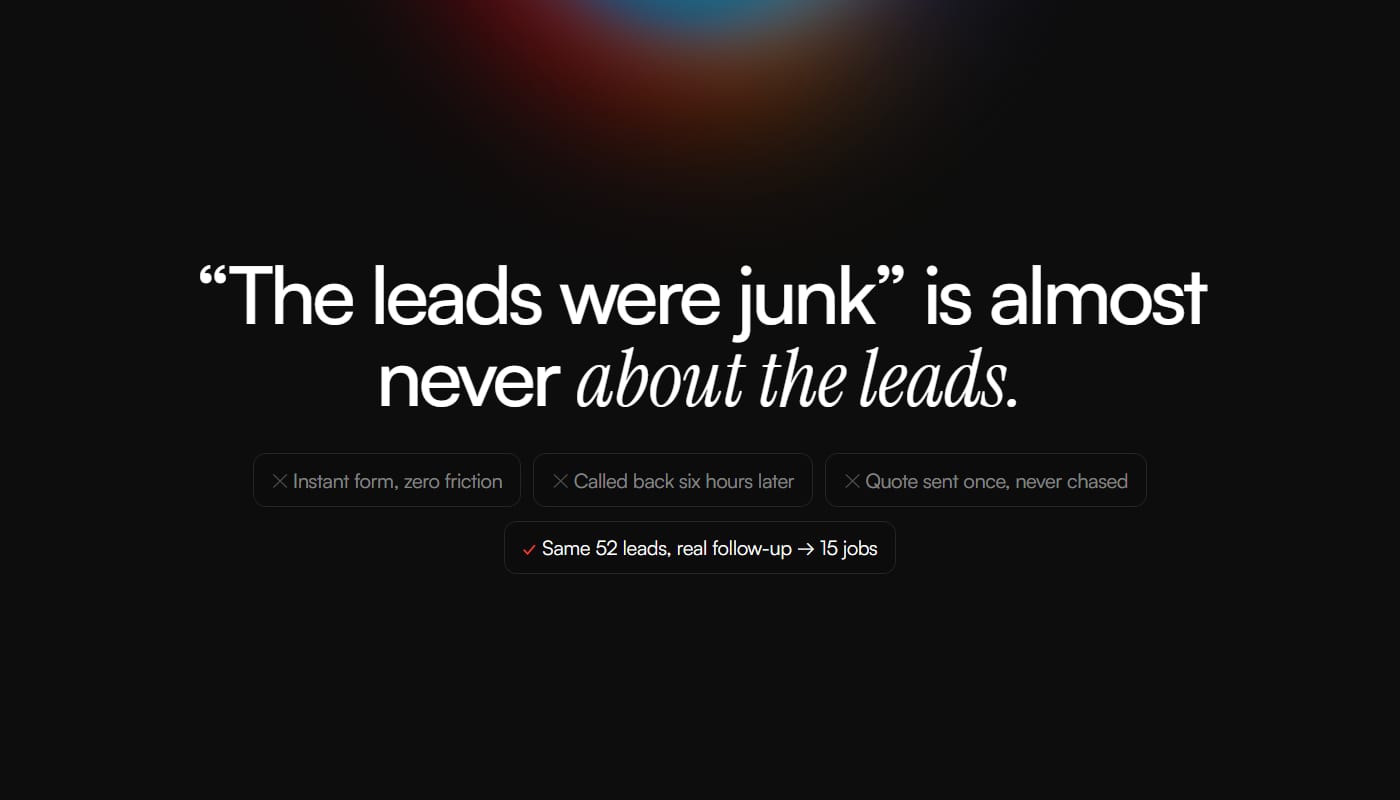
When a service business says "the leads were junk", the cause is almost always one of three things: an instant form that collected anyone curious, a reply that came hours late, or a quote that was sent once and never chased. Fix those and the same traffic source starts producing booked jobs — on our landscaping account, 52 leads became 15 closed jobs.
Ask any service business owner who's tried paid leads before what went wrong, and you'll hear some version of the same sentence: "the leads were junk." It's a fair thing to assume — you paid for enquiries, few of them turned into jobs, so the enquiries must have been the problem. In our experience, they almost never are.
The gap is speed, not traffic
A homeowner comparing roofers doesn't fill out one form. They fill out three or four, on three or four different company sites, in the same afternoon. Whoever calls back first usually gets the inspection. If your crew is on a roof and nobody answers for six hours, you didn't lose a bad lead — you lost a good one to whoever answered first.
On our roofing case study, the winning ad set converted every single one of its leads into a booked inspection. Same traffic source, same targeting, same offer as the ad sets that underperformed. The difference wasn't lead quality — it was which creative reached the right person, and how fast the follow-up system responded once they did.
The second gap is the estimate nobody chased
The inspection happens, the quote goes out, and then — nothing. No second touch, no reminder, no reason for the homeowner to pick you over whoever calls them next week. That quote isn't dead, it's just unchased. On our landscaping case study, the difference between a $17 lead and a booked job wasn't the ad — it was a custom qualifying form that filtered for real intent, paired with follow-up that kept working the quote instead of writing it off after one call.
The same 52 leads, run through a system with real follow-up, turned into 15 closed jobs. Run through no system at all, most of them would have gone nowhere.
What "quality" actually means
When we hear "the leads were junk," we usually find one of three things on closer look:
- The form was too easy. Meta's one-tap instant forms collect anyone who was mildly curious, not just people who want a quote.
- Nobody answered fast enough. A lead that sits for hours is a lead that's already talked to a competitor.
- The quote was sent and forgotten. No follow-up sequence means the job goes to whoever chased it, not whoever quoted it first.
Fix those three things and the exact same traffic source that "didn't work" usually starts producing booked jobs. That's the whole premise behind the system we build for every client — the ads matter less than what happens in the sixty seconds after someone fills out the form, and the two weeks after the estimate goes out.
Common questions
How fast should a service business reply to a new lead?
Within minutes. Homeowners fill in three or four forms in the same afternoon and usually book with whoever calls first. Our system contacts every enquiry in under five minutes during active hours.
Are Meta instant forms bad for lead quality?
They collect volume, not intent — one tap and the form is submitted. A custom form with two or three qualifying questions removes the mildly curious before anyone at your company spends time on them.
What should happen after an estimate is sent?
A follow-up sequence that keeps working the quote — a message a few days later, then a week, then a month. Most unchased quotes are not lost; they are simply unchased.